


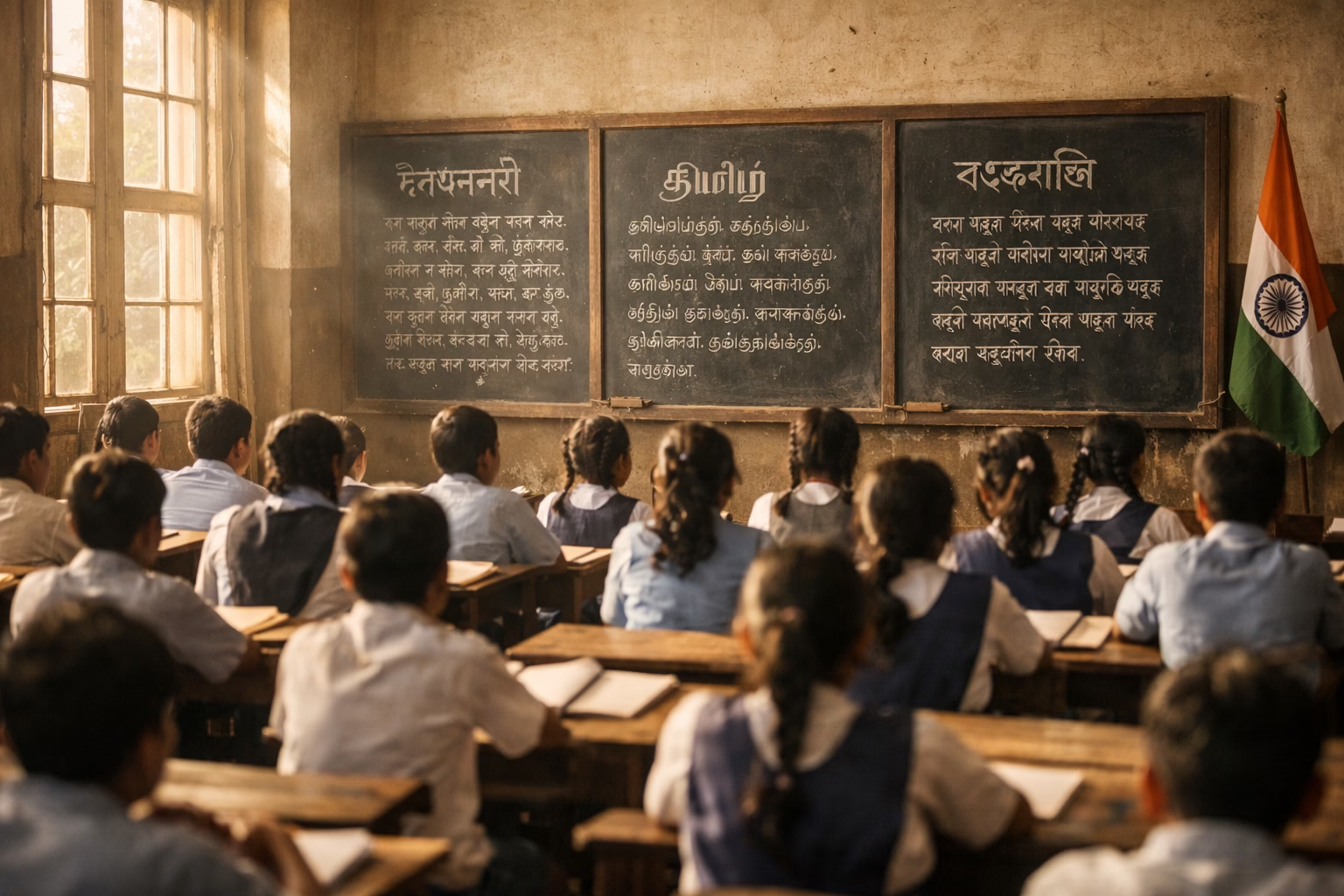
CBSE’s Three-Language Mandate:
A Complete Study of the NEP 2020 Reform
An exhaustive, research-backed analysis of the Central Board of Secondary Education’s landmark decision to implement the three-language formula from Class VI — its origins, architecture, implementation roadmap, controversies, and national significance.
Executive Summary
In April 2026, the Central Board of Secondary Education (CBSE) announced one of the most consequential reforms to Indian school education in decades — the mandatory implementation of a three-language formula beginning from Class VI in the academic session 2026–27. This decision directly implements the language education philosophy enshrined in the National Education Policy (NEP) 2020 and operationalised through the National Curriculum Framework for School Education (NCF-SE) 2023.
Under the new framework, all students in CBSE-affiliated schools will be required to study three languages — designated R1, R2, and R3 — of which at least two must be languages native to India. This represents a structural departure from the prevailing two-language system. The third language (R3) will be introduced in Class VI from 2026–27 and progressively extended to Class X by 2030–31, with the first board examinations covering all three languages scheduled for 2031.
The announcement has simultaneously generated national acclaim for its multilingual vision and sharp political controversy — particularly regarding the status of English as a “foreign language” and fears in non-Hindi speaking states of covert Hindi imposition.
Historical Background of the Three-Language Formula
India’s three-language formula has deep historical roots, tracing back to the earliest post-independence deliberations on national identity, linguistic unity, and federal autonomy. Understanding this history is essential to appreciating both the intent of the current reform and the intensity of resistance it provokes.
The Radhakrishnan Committee (1948–49)
The concept of a structured multi-language education policy was first mooted by the University Education Commission chaired by Dr. S. Radhakrishnan in 1948–49. The Commission recommended that students be exposed to multiple languages to foster national integration in a newly independent, linguistically fractured nation.
The Kothari Commission (1964–66)
The Education Commission of 1964–66, chaired by D.S. Kothari, formally proposed the three-language formula. It recommended that students learn: (1) the regional language or mother tongue, (2) Hindi (for non-Hindi-speaking states) or another modern Indian language (for Hindi-speaking states), and (3) English or a modern European language.
Historically, the formula was implemented unevenly. Tamil Nadu, with its deep-rooted anti-Hindi agitation history (particularly the violent protests of 1965), followed a strict two-language policy — Tamil and English only — and never implemented the three-language formula. Several other states followed similarly inconsistent paths. The new CBSE mandate marks a determined attempt to finally standardise and universalise the formula across all CBSE-affiliated schools nationwide.
NEP 2020 — Language Education Provisions
The National Education Policy 2020, released by the Government of India on July 29, 2020, is the first comprehensive overhaul of India’s education policy since 1986. It carries extensive and nuanced provisions on language education at the school level.
Mother Tongue as Medium of Instruction
NEP 2020 establishes a clear preference for the mother tongue or home language as the medium of instruction. The policy states that wherever possible, instruction should be in the home language, mother tongue, local, or regional language at least until Grade 5, and preferably up to Grade 8 and beyond. This recommendation is grounded in extensive cognitive and pedagogical research showing that children learn best in their first language.
Three-Language Formula — NEP 2020’s Version
NEP 2020 retains the three-language formula but fundamentally re-architectures it compared to the 1968 version. The critical distinctions are:
- Flexibility over mandate: Unlike NPE 1968, which required Hindi in non-Hindi states, NEP 2020 explicitly states that “no language will be imposed on any State.”
- Two-of-three Indian language rule: At least two of the three languages students learn must be native to India.
- Student/state choice: The languages learned will be the choices of States, regions, and the students themselves.
- Sanskrit emphasis: NEP 2020 specifically mentions that Sanskrit should be a mainstream option offered at all levels of schooling, including as the third language in the three-language formula.
- Foreign languages: One of the three languages may be a foreign language, including English, enabling students to pursue global opportunities.
- Tribal and indigenous languages: NEP 2020 emphasises preservation of tribal and indigenous languages through their inclusion in the school curriculum.
- Cognitive benefits acknowledged: The policy explicitly recognises research showing bilingual and multilingual education improves cognitive ability, creativity, and empathy.
Medium of Instruction Policy
NEP 2020’s instruction medium policy is a significant corollary to the three-language mandate. The policy recommends that wherever feasible, the medium of instruction through at least Grade 5 should be the home/mother tongue. This recommendation is applicable across government and private schools and is expected to positively impact foundational literacy and numeracy, especially among first-generation learners from rural and tribal backgrounds.
NCF-SE 2023 — The Curriculum Framework Basis
The National Curriculum Framework for School Education 2023 (NCF-SE 2023), released by the National Steering Committee under the chairmanship of Dr. K. Kasturirangan, translates NEP 2020’s broad policy directions into a practical curriculum framework for schools. The NCF-SE 2023 directly provides the structural scaffolding for the R1/R2/R3 language framework now being implemented by CBSE.
The NCF-SE 2023 mandates that:
- Languages be organised into three structured levels — R1 (First Language), R2 (Second Language), and R3 (Third Language) — across all school stages.
- Two of these three languages must be languages native to India at every stage.
- The curriculum must be structured to ensure depth and progression across all three language levels, with differentiated syllabi and assessment frameworks.
- NCERT is responsible for developing level-appropriate textbook series for each language at each R-level.
The NCF-SE 2023 forms the direct legal and curricular basis for CBSE’s April 2026 curriculum announcement. CBSE’s curriculum document explicitly cites NCF-SE 2023 recommendations as the authoritative source for the two-Indian-languages requirement.
CBSE’s Decision — Full Details
The Central Board of Secondary Education (CBSE), India’s largest school board with over 28,000 affiliated schools across the country and abroad, formally announced its new Curriculum 2026–27 in early April 2026. The announcement was made during a national webinar chaired by CBSE Chairperson Rahul Singh, who described the rollout as a “seminal moment” in Indian education.
The Core Decision
The central decision is unambiguous: from the academic session 2026–27, CBSE mandates that all students in affiliated schools must study three languages from Class VI onwards. The CBSE curriculum document states:
Key Structural Features
| Feature | Detail |
|---|---|
| Effective From | Academic Session 2026–27 (Class VI) |
| Language Levels | R1 (First Language), R2 (Second Language), R3 (Third Language) |
| Indian Language Requirement | Minimum 2 of 3 languages must be native to India |
| Language Options | 44 languages listed by CBSE, including all 22 Eighth Schedule languages |
| R3 Textbook Availability | R3 textbooks (NCERT co-developed) expected online in April 2026 |
| School Flexibility | Choice of second Indian language left to individual schools |
| Board Exam Integration | Full three-language board exam from 2031 (Class X batch of 2026) |
| Exceptions | Students returning from foreign schools may be exempt from R3 under specific conditions |
The R1, R2, R3 Framework — Detailed Explanation
The three-language mandate is operationalised through a structured hierarchical framework of three language levels: R1, R2, and R3. Each level carries distinct academic expectations, differentiated syllabi, and separate assessment structures.
| Level | Name | Definition | Academic Depth | Key Rule |
|---|---|---|---|---|
| R1 | First Language | Primary/dominant language of the student — typically mother tongue or Hindi | Advanced level — highest proficiency, deepest literature and grammar coverage | Any language offered by CBSE |
| R2 | Second Language | Secondary language studied at a moderate proficiency level | Intermediate level — functional communication, standard grammar | Must be different from R1 |
| R3 | Third Language | New language introduced at Class VI (2026–27), phased to Class X by 2030–31 | Introductory to functional level — script, vocabulary, basic communication | Must be different from R1 and R2; compulsory from Class VI |
The Two-Indian-Languages Mandate
The most consequential rule within the R1/R2/R3 framework is that at least two of the three languages chosen by a student must be languages native to India. This means a student who wishes to take English as one of their three languages must ensure their other two choices are Indian languages. This rule effectively means that English — for the first time in modern Indian school policy — cannot be treated as a default first language in a CBSE curriculum that also counts as satisfying the three-language requirement without pairing it with two Indian languages.
Assessment Differentiation
Even where the same textbooks are used at the introductory level, the R1, R2, and R3 tracks will have separate question papers and different levels of difficulty in assessments. This ensures that students are evaluated at the appropriate level of proficiency rather than being tested uniformly, acknowledging that a native Tamil speaker studying Tamil as R1 should face different expectations from a Hindi-medium student studying Tamil as R3.
The “Same Language” Prohibition
An important structural rule: the same language cannot be chosen for both R1 and R2. This prevents students from gaming the system by listing the same language at two levels to avoid genuinely studying a second or third language. Every R-level must represent a meaningfully distinct language.
The 44 Languages — Scope and Eighth Schedule Coverage
A landmark feature of CBSE’s 2026–27 curriculum announcement is its explicit listing of 44 languages from which students may choose their R1, R2, and R3 options. This comprehensive list covers all 22 languages in the Eighth Schedule of the Constitution of India as amended, plus additional scheduled and classical languages.
- Assamese · Bengali · Bodo · Dogri · Gujarati · Hindi · Kannada · Kashmiri · Konkani · Maithili
- Malayalam · Manipuri · Marathi · Nepali · Odia · Punjabi · Sanskrit · Santali · Sindhi · Tamil · Telugu · Urdu
Beyond the 22 Scheduled Languages, CBSE’s list of 44 includes additional classical languages recognised by the Government of India, foreign languages with significant student interest (such as French, German, Spanish, Japanese, Chinese, Arabic), and languages of educational significance. This brings the total to 44 options, making CBSE’s language offering one of the most comprehensive among major school boards globally.
Significance of the Full Language List
The inclusion of all Eighth Schedule languages is not merely symbolic. It means that a student in Assam can study Bodo as R3, a student in Jharkhand can study Santali, and a student in Jammu can study Dogri — all within the formal CBSE examination framework. This is a direct implementation of NEP 2020’s vision of preserving and promoting India’s endangered and regional languages through mainstream education.
NCERT, in collaboration with CBSE, is developing level-appropriate (R1/R2/R3) textbooks for each of these languages. The Kaveri series has been announced specifically for English under this restructured framework.
Implementation Roadmap & Board Examination Timeline
CBSE has adopted a carefully phased approach to the implementation of the three-language formula, acknowledging that a simultaneous system-wide rollout would be logistically impossible across 28,000+ schools and millions of students. The roadmap spans 2026 to 2031.
| Year / Session | Milestone | Classes Affected |
|---|---|---|
| 2026–27 | R3 (Third Language) made compulsory from Class VI. R3 textbooks introduced (CBSE–NCERT collaboration). New Scheme of Studies for Class 9 also kicks in. AI curriculum for Classes 3–8 launched. | Class VI (new entrants) |
| 2027 | Last board examinations under the current (two-language) textbook system. Vocational education becomes mandatory for Classes 9–10. | Class X (2027 board batch) |
| 2028 | First board exams under new system: two-day examination for R1 and R2. First Class 10 board exams under two-level Mathematics and Science system. | Class X (2028 board batch) |
| 2029 | First board examinations for Computational Thinking and Artificial Intelligence (CT/AI) subject. | Class X (2029 board batch) |
| 2030–31 | R3 extended to Class X. Three-language formula fully operational across all secondary classes. | Classes VI–X |
| 2031 | First board exams covering all three languages — R1, R2, and R3 — conducted over three days. Full implementation of the CBSE three-language formula complete. | Class X (2031 board batch — the Class VI cohort of 2026) |
Exemptions During Transition
Recognising logistical ground realities, CBSE has built in a key transitional exception: students returning from foreign schools where the third language studied till Class VIII or IX is not available in CBSE’s list may be exempted from the R3 requirement under specific, exceptional circumstances. This provision safeguards internationally mobile students from undue disadvantage during the transition period.
Other Major Accompanying Reforms — Curriculum 2026–27
The three-language mandate is not an isolated change. CBSE’s Curriculum 2026–27 is a comprehensive, multi-pronged reform package aligned with NEP 2020. The following significant changes accompany the three-language formula:
Two-Level Mathematics and Science (Class IX)
From 2026–27, CBSE introduces a two-level system in Mathematics and Science for Class 9. All students take a standard 80-mark, three-hour examination. Students who seek higher proficiency may additionally attempt an advanced 25-mark, one-hour paper focused on higher-order thinking and conceptual depth. Crucially, marks from the advanced paper are not included in the student’s overall aggregate — removing any risk penalty — but students scoring 50% or above receive a separate notation on their Class X mark sheet, signalling aptitude for competitive examination pathways (JEE, NEET). The first board exams under this system for Class X will be held in 2028.
Computational Thinking and Artificial Intelligence (Mandatory)
CBSE introduces Computational Thinking and Artificial Intelligence (CT/AI) as compulsory subjects for Classes 9 and 10. The curriculum for CT/AI is already being rolled out for Classes 3–8 in the 2026–27 session. Structured modules for secondary classes will be introduced from 2027 onwards, with the first board examinations in this subject expected in 2029.
Mandatory New Subject Areas (Classes 9–10)
Four subject areas that were previously absent, optional, or irregularly implemented are being made compulsory for all Class 9 and 10 students:
- Vocational Education — Mandatory from Class 9 from 2027–28. Textbooks and structured curriculum under development.
- Art Education — Mandatory with school-based assessment in 2026–27; board examinations phased in subsequently.
- Physical Education — Mandatory with new textbooks introduced in the current session.
- Interdisciplinary Studies — New subject bridging multiple disciplines.
These four new compulsory areas are assessed through internal school examinations initially, with a phased transition to a hybrid model incorporating board exam components for vocational subjects from 2028–29.
The English Question — Foreign Language or First Language?
Perhaps the most widely discussed — and widely misunderstood — aspect of the CBSE three-language announcement is the status of English in the new framework. The issue has generated headlines, political debates, and parental anxiety in equal measure.
What the Policy Actually States
Under the new framework, because only one “foreign” language is permitted in a student’s three-language combination, and because English is technically classified as a language not native to India, it falls within the “foreign language” category alongside German, French, Spanish, Japanese, etc. The policy requires that two of the three languages must be Indian languages.
This does not mean English is banned or even discouraged. A student can still study English as one of their three languages. However, if they do, their other two choices must both be Indian languages. Under the old system, many CBSE students essentially studied English (as R1) and one Indian language — with no genuine third language requirement. The new system ends this de facto English-dominant two-language pattern.
The Debate Among Educators
The classification of English has created a sharp divide among school principals and educators. Some, like Sudha Acharya, Principal of ITL Public School, Delhi, have publicly stated that the controversy is misplaced, noting that “there is no source which says English is a foreign language” and that practical implementation at school level will not dramatically alter English’s centrality in education. Others argue that the formal reclassification carries symbolic and potentially practical significance for English-medium schools.
Practical Impact on English-Medium Schools
For the majority of urban CBSE-affiliated schools that function as English-medium institutions, the practical implication is that students must now genuinely study two Indian languages in addition to (or alongside) English, rather than treating one Indian language as a token second language and English as the dominant academic medium across all subjects. The Kaveri series (NCERT’s new English textbook series) is designed to position English within this new framework.
Political Controversies & State Responses
Tamil Nadu — The Epicentre of Opposition
The sharpest resistance to the three-language formula has come from Tamil Nadu. The state’s Chief Minister M.K. Stalin issued a direct public challenge to the Central Government, accusing the BJP-led Union Government of using education reforms as a “covert mechanism to impose Hindi on non-Hindi-speaking states.” Stalin addressed a massive rally in Sankarankovil on this issue, framing the three-language mandate as a direct threat to Tamil linguistic heritage.
Tamil Nadu’s opposition is grounded in decades of political history. The state witnessed violent anti-Hindi agitations in 1965, and both the ruling DMK and the opposition AIADMK have maintained an unwavering two-language policy (Tamil and English) ever since. The prospect of a mandatory third language — which many Tamilians assume would inevitably be Hindi — is perceived as a civilisational threat rather than merely an educational policy change.
Centre’s Position
Union Education Minister Dharmendra Pradhan dismissed Tamil Nadu’s allegations as a “tired attempt to mask administrative failures” ahead of upcoming elections. The Centre’s official position is that NEP 2020 offers “greater flexibility” and that no language is being forced. Pradhan emphasised that the goal is to make Indian students “multilingual global leaders” and that the choice of Indian language for R3 rests entirely with schools and students, not the Central Government.
CBSE sources have specifically stated there is “no plan” to push Hindi as one of the two mandatory Indian languages, underlining that a Tamil Nadu student could, for instance, satisfy the requirement by studying Tamil (R1), English (R2), and Telugu or Malayalam (R3) — with no Hindi involved.
Financial Leverage — Samagra Shiksha Funds
The political stakes are materially significant. The Union Government has withheld approximately ₹2,152 crore in Samagra Shiksha education funds from Tamil Nadu for the state’s refusal to join the PM SHRI scheme, which is conditioned on NEP 2020 compliance. Tamil Nadu has called this “blackmail” and questioned the constitutional basis of such conditions on concurrent-list education funding.
Other States’ Responses
Tamil Nadu is not alone in its concerns. States including Kerala, West Bengal, Karnataka, and Maharashtra have raised varying degrees of concern about the three-language formula, with the common thread being resistance to perceived linguistic domination by Hindi-speaking northern states. Maharashtra’s earlier scrapping of a three-language policy following protests by NCP and other stakeholders illustrates the political volatility of this issue. The three-language formula sits at the intersection of language, culture, identity, and federal power — making it among the most politically charged elements of NEP 2020.
The Constitutional Framework
Education in India is a Concurrent List subject under the Seventh Schedule of the Constitution, meaning both the Centre and state governments have legislative authority over it. This constitutional arrangement is the basis of states’ argument for autonomy in language education. The CBSE three-language mandate legally applies only to CBSE-affiliated schools, not to state board schools. However, states worry that the NEP’s framework will progressively be used to push state boards toward the same curriculum architecture.
Impact Analysis — Schools, Students & the Education Ecosystem
For Students
The most immediate impact is on Class VI students enrolled in CBSE schools from 2026–27. These students, who will sit for their Class X board examinations in 2031, will be the first generation to take a three-subject language examination across R1, R2, and R3. For many students, particularly those from Hindi-medium or English-medium backgrounds in urban schools, this will mean genuinely learning a regional or classical Indian language (such as Sanskrit, Tamil, Odia, or Marathi) for the first time.
For Schools
CBSE’s approximately 28,000 affiliated schools face significant logistical challenges:
✦ Potential Benefits
- Richer multilingual learning environment that reflects India’s civilisational diversity
- Stronger foundational literacy through mother tongue emphasis
- Preparation for a multilingual job market and global economy
- Revival of endangered Indian languages through formal education
- Cognitive benefits of multilingualism — improved problem-solving, memory, and empathy
- Stronger national integration through cross-linguistic exposure
✦ Challenges & Concerns
- Acute shortage of qualified teachers for many regional languages, especially in distant states
- Inadequate learning materials in many tribal, minor, and regional languages
- Risk of overburdening students from disadvantaged or low-literacy households
- Infrastructure gaps between urban and rural schools in implementing multilingual curricula
- Political resistance potentially hampering uniform national implementation
- Difficulty in maintaining quality and consistency across 44 language options
For the NCERT Publishing Infrastructure
The reform places enormous demands on NCERT. The body must develop three distinct levels (R1, R2, R3) of textbooks for potentially dozens of languages — a publishing and pedagogical undertaking of extraordinary scale. CBSE has announced that R3 textbooks, co-developed by CBSE and NCERT, are expected to be made available online in April 2026, just as the new academic session begins. The phased rollout up to 2031 gives NCERT a five-year window to progressively extend textbook availability to all classes.
For Competitive Examinations
The new language framework will have downstream effects on competitive examinations such as JEE, NEET, and civil service examinations, which traditionally weigh Class X results. The notation of advanced Mathematics and Science on mark sheets (separate from the three-language board exams) is designed to allow students to signal their STEM aptitude without being penalised in their language examination performance.
Critical Assessment — A Balanced Evaluation
The CBSE three-language mandate, examined dispassionately, is both a bold and a complex policy intervention. Its merits and limitations deserve careful, evidence-based assessment.
What the Policy Gets Right
The policy is on strong pedagogical ground. A substantial body of research — including UNESCO recommendations — endorses mother tongue instruction in the early years and multilingual education as a cognitive and academic benefit. India’s extraordinary linguistic diversity, with over 19,500 dialects and 121 languages, makes the three-language formula not merely a policy ideal but a practical necessity for national cohesion and equitable education.
The decision to give schools flexibility in the choice of Indian language for R3 — rather than mandating Hindi — is a politically wise and constitutionally respectful departure from the 1968 formula. It addresses the core concern of southern states while preserving the multilingual objective.
Where Challenges Remain
The policy’s success will ultimately depend not on the curriculum document but on classroom implementation. The three most significant structural challenges are: (1) the availability of trained teachers for 44 languages across India’s vast geographic and socioeconomic landscape; (2) the production of high-quality, level-differentiated teaching materials by NCERT in time for each phase of the rollout; and (3) the management of student workload in an already heavily loaded secondary curriculum, now expanded to include three languages plus vocational education, AI, art, and physical education.
There is also a legitimate concern that for students from socioeconomically marginalised backgrounds — those already struggling with foundational literacy — a mandatory third language could increase dropout pressure or academic anxiety rather than expanding horizons. The policy’s equity dimensions require careful monitoring and targeted support for vulnerable student groups.
The Federal Dimension
The tension between CBSE’s mandate and Tamil Nadu’s two-language policy highlights a deeper structural issue in Indian federalism. The fact that CBSE-affiliated schools exist in every state — including Tamil Nadu — means the Board’s curriculum decisions effectively override state preferences for students enrolled in CBSE schools. Whether this constitutes an appropriate exercise of the Centre’s educational role or an overreach into a concurrent-list domain will continue to be legally and politically contested.
Conclusion
The CBSE’s three-language mandate, effective from Class VI in academic session 2026–27, is a landmark moment in India’s post-independence education history. It represents the culmination of a 58-year policy journey from the Kothari Commission’s 1964–66 proposal to the NEP 2020’s evolved, flexible vision, now finally standardised and operationalised by CBSE across its vast school network.
The R1/R2/R3 framework is architecturally sound: it acknowledges differential language learning needs, provides genuine flexibility in language choice, mandates cultural rootedness through the two-Indian-language rule, and gives NCERT a structured mandate for textbook development. The phased implementation timeline through 2031 is realistic and avoids the chaos of a big-bang rollout.
Yet the policy faces real headwinds — from political resistance rooted in deep historical fears of linguistic domination, to practical challenges of teacher supply and material development. The ultimate verdict on this reform will not be written in curriculum documents or political rallies but in classrooms across India, in the linguistic competence, cultural literacy, and academic confidence of the first cohort of students who will take their three-language board examinations in 2031.
For India — a nation that speaks in hundreds of tongues but aspires to speak in one national voice — the three-language formula is not just an education policy. It is a statement of civilisational intent: that linguistic diversity is not a problem to be managed but a heritage to be celebrated, taught, and carried forward by every generation of young Indians.
Discover more from News 24 Media
Subscribe to get the latest posts sent to your email.