


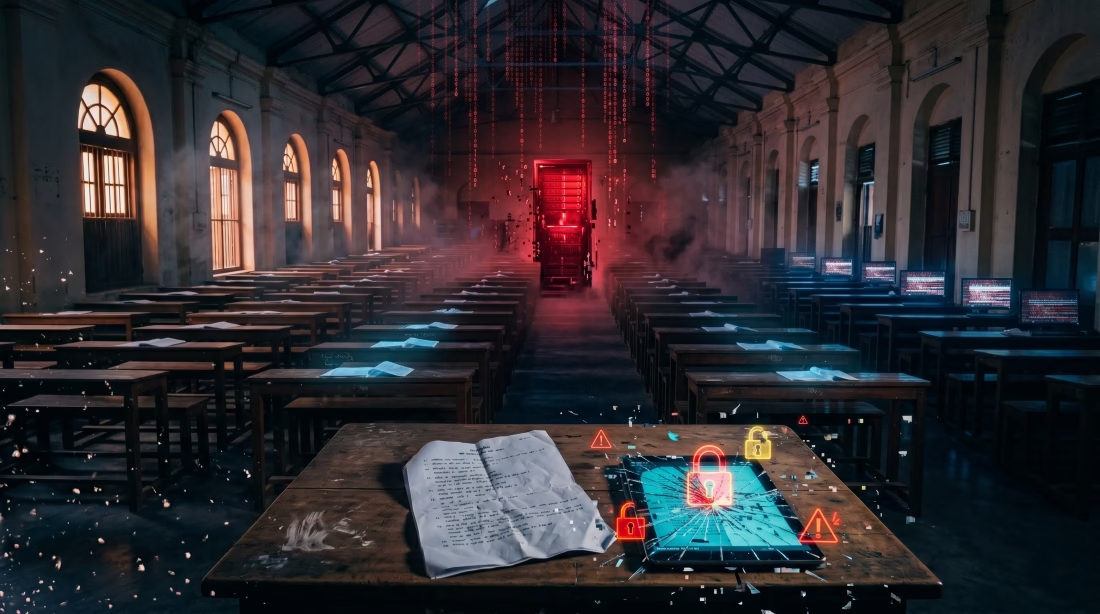
CBSE’s Digital Gamble Gone Wrong: CBSE OSM, Cyberattacks and the Crisis of a Nation’s Board Exams
India’s biggest education board staked its credibility on a rushed digital transition. The result: a seven-year low in pass rates, 1.63 lakh students pushed to compartment exams, 1.5 million cyberattack hits in two minutes, and the removal of its top two officials.
(7-Year Low)
Compartment
in 2 Minutes
Applications
In India, Class 12 board results are not merely numbers. They are the gateway to college admissions, professional programmes, scholarships, and for millions of families, a measure of hope. That is precisely why what unfolded in May and June 2026 struck so deep — not just as an administrative controversy, but as a crisis of institutional trust at the most sensitive moment in a student’s academic life.
The Central Board of Secondary Education declared Class 12 results on May 13, 2026. The pass percentage stood at 85.20% — a sharp decline of 3.19 percentage points from 88.39% in 2025, and the lowest pass rate in seven years. Out of 17,68,968 students who appeared, 1,63,800 were placed in the compartment category, meaning they must attempt supplementary examinations scheduled for July 15, 2026 to secure their year.
Almost immediately, students and parents flooded social media with complaints — not only about lower marks, but about suspected errors in scanning, mismatched answer sheets, and missing pages. The questions pointed at a single, contentious decision: the introduction of On-Screen Marking, or OSM, for the evaluation of Class 12 answer books for the very first time in 2026.
What Is On-Screen Marking — And Why It Was Introduced
On-Screen Marking is a digital evaluation system in which physical answer sheets are scanned and uploaded to a secure platform, where examiners assess them on computer screens rather than handling paper copies. CBSE formally announced OSM for Class 12 in February 2026, describing it as a landmark step in its digital reform agenda.
The board outlined a compelling case: CBSE OSM would eliminate totalling errors, reduce manual coordination, accelerate the declaration of results, and allow teachers to evaluate from their own schools without travelling to centralised marking centres. It also promised better record-keeping and the possibility of providing students with scanned copies of their evaluated answer sheets at a later stage — a long-standing demand from student advocates.
Elimination of totalling and posting errors in marks | Remote evaluation by teachers from their own schools | Faster result processing | Reduced transportation logistics and costs | Better digital record-keeping of answer scripts | Potential reduction in post-result disputes through improved accuracy
CBSE had experimented with on-screen marking in limited subjects as far back as 2013–14, with mixed results — satisfactory in some regions like Panchkula, but beset with difficulties in Prayagraj, Patna and Ajmer. The 2026 rollout was a full-scale deployment across all Class 12 subjects for nearly 18 lakh students — a scale exponentially larger than any previous trial.
What Went Wrong: Warning Signs, Glitches and Student Anxiety
The cracks appeared well before results were declared. During a mandatory mock evaluation session held on February 26, 2026, teachers reported portal access failures, slow system performance, inadequate internet connectivity in participating schools, and errors in teacher data on the OASIS portal — the backbone of the CBSE OSM administrative system. A senior teacher from a Delhi-based school went on record describing the system as experiencing persistent glitches, with subjects like Business Studies and Biology barely commenced even weeks after the board examinations had concluded.
When results were declared on May 13, widespread student complaints followed almost instantly. The concerns centred on a specific and disturbing set of possibilities: that answer sheets may have been scanned incompletely or incorrectly; that evaluators may have marked the wrong student’s work; that pages may have gone missing in the digitisation process; and that totals may have been computed erroneously even under a system designed to prevent such errors.
“For over four lakh students who applied for scanned copies, the process was itself traumatic: portal crashes, inflated fees, illegible PDFs, and uncertainty about whether their answer sheets had been correctly digitised at all.”
— The Probe, Independent Analysis, May 2026What amplified the anxiety was CBSE’s own initial decision to discontinue post-result verification of marks for Class 12 — a step it had announced alongside the CBSE OSM rollout, on the grounds that digital evaluation would make verification redundant. Students who had questions about their marks thus found themselves in a system that had removed a familiar safety valve before a new, proven alternative was in place.
The Cybersecurity Crisis: 1.5 Million Hits in Two Minutes
On June 2, 2026, CBSE launched its post-result services portal — the platform through which students could apply for scanned copies of their answer sheets, mark verification, and re-evaluation. What followed was a dual assault: a massive legitimate surge of student traffic and a coordinated cyberattack.
CBSE’s own statement on X confirmed that its re-evaluation and verification portal faced a Denial-of-Service attack causing 1.5 million hits on the portal within a matter of two minutes. In the same period, over one lakh attempts to gain unauthorised access to files hosted on the system were also recorded. Despite the disruption, the board stated that the portal continued to function from 7 AM, and that over 8,000 concurrent users were accessing it simultaneously by mid-afternoon, with more than 16,000 students having successfully completed their submissions by 3:00 PM.
Cybersecurity Incidents — Verified Facts
- Denial-of-Service attack: 1.5 million hits on the re-evaluation portal within 2 minutes on June 2, 2026
- Over 1 lakh attempts at unauthorised file access recorded in the same window
- An AWS (Amazon Web Services) cloud storage bucket containing scanned 2026 exam records was allegedly accessible publicly without login credentials
- Ethical hacker Nisarga Adhikary alleged scanned answer sheets and question papers could be browsed and downloaded from the AWS repository without authentication
- CBSE filed a complaint with Delhi Police’s IFSO (Intelligence Fusion and Strategic Operations) unit
- CBSE stated no data breach was detected and databases were not compromised
- Security experts from IIT Madras, IIT Kanpur and the Digital Infrastructure Corporation of India were deployed for a comprehensive platform audit
- Data was shifted to government-controlled cloud infrastructure as part of security hardening
The AWS vulnerability allegation was among the most serious. CBSE, in its May 31 statement on X, acknowledged the reported issues and confirmed: “The identified vulnerabilities have been contained, and other exploitable weaknesses are being ruled out.” The board also took the unusual step of publicly thanking ethical hackers who had flagged weaknesses and invited further disclosures to its security team at secy-cbse@nic.in.
The critical distinction that CBSE maintained throughout — that attacks were attempted but no data breach was confirmed — is important. There is a meaningful difference between attempted intrusion and confirmed compromise. However, the very existence of exploitable vulnerabilities in a system holding the answer sheets of nearly 18 lakh students represents a governance failure that cannot be minimised.
Leadership Shake-Up: Chairperson and Secretary Removed
On June 3, 2026, the central government moved decisively. CBSE Chairman Rahul Singh and Secretary Himanshu Gupta were transferred amid the full weight of the controversy. Senior bureaucrats Lokhande Prashant Sitaram and Varun Bhardwaj were appointed as the new CBSE Chairman and Secretary respectively.
Simultaneously, the Cabinet Secretariat issued a memorandum constituting a one-member inquiry committee — headed by S. Radha Chauhan — to examine matters relating to the procurement of services for the CBSE OSM system. This was a direct response to allegations of anomalies in the tendering process used to select the technology vendor for on-screen marking.
Sarthak Sidhant, a 17-year-old Class 12 student from Ranchi, Jharkhand, appeared before the Parliamentary Standing Committee on Education, Women, Children, Youth and Sports on June 3, 2026. He presented a seven-page written submission documenting what he described as at least 15 discrepancies in CBSE’s tendering process for OSM vendor selection. The committee, chaired by Congress MP Digvijaya Singh, heard him and demanded responses from CBSE officials who appeared before it — including the now-transferred Chairman Rahul Singh. Sarthak’s act of civic engagement, a student holding a national institution to account before Parliament, became one of the most striking moments of the entire controversy.
The Parliamentary Committee on Education, Women, Children, Youth and Sports also took up the issue. CBSE submitted a report to the committee addressing student concerns and assured MPs that portal glitches had been rectified. The board extended the deadline for re-evaluation applications to June 6, 2026 — a direct concession to the scale of student anxiety and the volume of applications received.
Key Events: A Chronology of the Crisis
- February 2026 CBSE formally announces OSM for all Class 12 examinations. The CBSE Examination Controller describes it as a move to enhance “efficiency and transparency.” Post-result verification of marks is also discontinued for Class 12.
- February 26, 2026 Mandatory mock evaluation session reveals portal failures, slow performance, connectivity problems, and teacher data errors. Warning signs are not acted upon publicly.
- May 13, 2026 CBSE Class 12 results declared. Pass percentage at 85.20% — a 3.19% drop, lowest in seven years. 1,63,800 students placed in compartment. Student and parent backlash begins on social media.
- May 31, 2026 CBSE posts on X acknowledging cybersecurity vulnerabilities in the CBSE OSM platform. Confirms that IIT Madras, IIT Kanpur and government agencies have been deployed for a comprehensive security audit. States identified vulnerabilities are “contained.”
- June 1, 2026 CBSE’s post-result portal goes live with hardened security: web application firewalls, DDoS protection, secure authentication and monitoring activated. Fee structure set at ₹100 for scanned copies/verification and ₹25 per question for re-evaluation.
- June 2, 2026 Re-evaluation portal faces a massive DoS attack — 1.5 million hits in two minutes, over 1 lakh unauthorised access attempts. CBSE files complaint with Delhi Police IFSO unit. Portal continues to function. Over 16,000 successful submissions by 3:00 PM.
- June 3, 2026 CBSE Chairman Rahul Singh and Secretary Himanshu Gupta transferred. New appointments: Lokhande Prashant Sitaram (Chairman), Varun Bhardwaj (Secretary). One-member inquiry committee under S. Radha Chauhan constituted to probe OSM procurement. Sarthak Sidhant presents before Parliamentary Committee on Education.
- June 4, 2026 Over 70,433 applications received via the grievance portal — including 7,314 for verification of marks and 63,119 for re-evaluation of answer sheets.
- June 6, 2026 Extended deadline for re-evaluation applications closes at midnight. Supplementary examinations for compartment students scheduled for July 15, 2026.
The Scale of Student Distress: 70,000 Applications in Three Days
Numbers tell the story of scale. By June 4, 2026, over 70,433 applications had been filed through the post-result grievance portal. Of these, 7,314 were for verification of marks and 63,119 were for re-evaluation of evaluated answer sheets. These are not routine numbers. In previous years, re-evaluation applications typically ran into thousands, not tens of thousands. The volume itself is evidence of the depth of student distrust.
Behind each number is an individual student’s reality. The pass rate decline from 88.39% in 2025 to 85.20% in 2026 translates to tens of thousands of additional students facing compartment examinations — students who will now spend the months between June and July in uncertainty, waiting to know whether an error in a scanning process may have cost them their year. Regional disparities further complicated the picture: the lowest pass percentage in any single region was recorded in Prayagraj, Uttar Pradesh, at 72.43%.
CBSE took several corrective steps during the crisis: extending session time limits on the portal based on student feedback, offering full refunds in cases of overcharging during the application process, and setting fee structures at accessible levels (₹100 for verification, ₹25 per question for re-evaluation). These were welcome measures — but their necessity, driven by a national political controversy rather than proactive institutional empathy, is itself a commentary on how the rollout was managed.
The IIT Audit: What the Experts Found
CBSE’s deployment of cybersecurity specialists from IIT Madras and IIT Kanpur — alongside experts from the Digital Infrastructure Corporation of India — was both a remedial and a reputational measure. The board acknowledged that the security review had been underway “for several days” before its public May 31 statement, suggesting the vulnerabilities were identified earlier than the public was made aware.
The most serious allegation concerned an AWS cloud storage bucket containing scanned 2026 examination records that could be accessed publicly without login credentials — an elementary security failure in a system holding sensitive educational data for nearly 18 lakh students. Ethical hacker Nisarga Adhikary went public with claims that answer sheets and question papers within the repository could be browsed and downloaded without authentication.
“IIT Madras and IIT Kanpur were roped in as technical firefighters — tasked with stabilising a portal that should have been stress-tested before results were declared.”
— The Probe, Analysis, June 2026The Ministry of Education has separately set up a probe into the implementation and procurement aspects of the CBSE OSM project, examining how quality control mechanisms and vendor performance were managed. These parallel investigations — one by the one-member committee on procurement, one by the Ministry on implementation — suggest that accountability is being sought at multiple levels. The outcome of these probes will be decisive in determining whether the OSM project represented a systemic governance failure or a manageable transition challenge.
The Larger Question: Digital Reform Without Digital Readiness
It would be a mistake to read the CBSE OSM controversy as an argument against digital evaluation. The vision behind CBSE OSM is sound. Eliminating totalling errors, reducing logistical overhead, enabling wider teacher participation in evaluation, and creating a digitally auditable record of assessed answer scripts — these are legitimate and worthwhile goals for a board that evaluates over 2.5 crore answer sheets annually.
The failure was not of the idea. It was of the preparedness. The gap between the announcement of CBSE OSM and its full-scale deployment was narrow. The mock evaluation session in February 2026 revealed serious readiness issues that were not resolved before the actual examinations began. The security architecture of the platform was, by CBSE’s own subsequent admission, inadequate. The grievance infrastructure — the portal for students to access their scanned copies and apply for re-evaluation — was neither load-tested sufficiently nor secured against predictable attack vectors. Vendor selection, as the parliamentary committee and the one-member probe are now examining, may have been compromised by process irregularities.
What a Credible Digital Reform Requires
- Independent technical audit of the platform before deployment — not after controversy erupts
- Rigorous, transparent vendor selection with documented eligibility criteria and public tender records
- Mandatory load testing and penetration testing of all student-facing portals before going live
- Examiner training with verified connectivity and equipment standards at school level
- Parallel grievance infrastructure — not dependent on the same system that may itself be the source of errors
- A phased rollout: pilot with selected subjects and regions, evaluate outcomes, then scale
- Public communication protocols that are proactive, not reactive — students deserve to know about issues before results are declared
- Institutional accountability structures that operate before a crisis, not after Parliamentary scrutiny forces action
CBSE had historical precedent to draw from. Its 2013–14 OSM pilot already documented region-specific failures. International experience with large-scale digital evaluation — in the United Kingdom, Australia, and parts of Southeast Asia — consistently shows that transition requires multi-year preparation, independent technical oversight, and iterative rollout. India’s CBSE attempted to do in months what requires years.
Conclusion: Trust Cannot Be Digitised
The CBSE OSM controversy of 2026 will be studied as a case study in institutional overreach — the gap between the ambition of a reform and the rigour of its execution. The board set out to modernise India’s board examination system. The goal was right. The preparation was insufficient. The communication was poor. The accountability structures were slow to respond.
The removal of the CBSE Chairman and Secretary, the constitution of a procurement inquiry committee, the deployment of IIT experts as emergency technical responders, the extension of re-evaluation deadlines, the fee reductions — all of these are corrective. But none of them give back to the 1,63,800 students the certainty they deserved when their results were declared.
India’s examination ecosystem must digitalise. There is no alternative path for a country evaluating tens of millions of answer scripts annually. But digitalisation without security is exposure. Speed without readiness is risk. Reform without accountability is theatre.
The future of examination reform in India is digital — but trust cannot be digitised. Trust must be earned, examination by examination, through preparedness that precedes the exam, transparency that accompanies the result, and accountability that follows a failure. India’s students deserve nothing less.
CBSE Curriculum Revolution 2026: How NEP 2020 Is Transforming Indian Education for the Better
Discover more from News 24 Media
Subscribe to get the latest posts sent to your email.