


📅 Updated: July 31, 2025 | 🖊️ By Editorial Team, News24Media.org
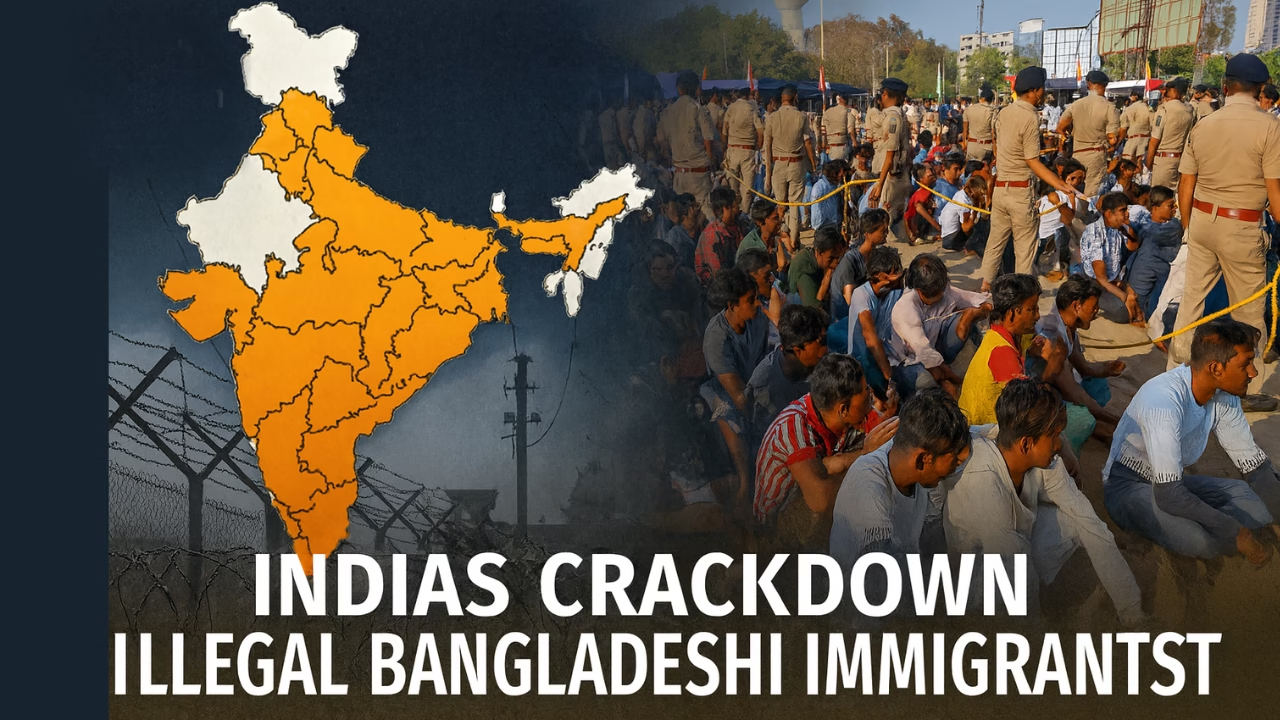
New Delhi — In the weeks following Operation Sindoor, India has intensified a widespread crackdown on illegal bangladeshi immigrants—particularly undocumented Bangladeshi nationals—across multiple states. The intelligence-led initiative, initially launched as an anti-terror and national security operation in the Northeast, has triggered a cascading wave of action by enforcement agencies nationwide. However, a curious silence prevails in politically sensitive states, where minority vote-bank politics seem to be slowing or even stalling enforcement efforts.
🔍 The Operation and Its Aftermath
Launched covertly in mid-2025, targeted a nexus of infiltrators, arms smugglers, and human traffickers operating along the India-Bangladesh border. The operation—led by central agencies such as the National Investigation Agency (NIA), Intelligence Bureau (IB), and Border Security Force (BSF)—revealed alarming data. Infiltration routes through Assam, Tripura, and West Bengal had led to a spike in illegal settlement patterns across India.
Delhi: Major illegal immigration network busted; 47 Bangladeshis arrested, 100 under scanner
While the border states were obvious hotspots, what caught national attention was the deep inland penetration of illegal Bangladeshi immigrants—now firmly entrenched in metropolitan hubs like Delhi, Gurugram, Ahmedabad, Hyderabad, and Mumbai.
Authorities have quietly launched identity verification drives, door-to-door surveys, and data-matching with the government databse and records and Aadhaar databases to identify and detain such individuals.
📍 The Disappearing Act in Posh Colonies
In a surprising trend noticed in affluent neighborhoods of Delhi and Gurugram, employers have recently reported the sudden disappearance of domestic helpers, many of whom were suspected to be illegal bangladeshi immigrants possessing falsified Aadhaar cards or voter IDs.
Gurugram cries for help: Househelps, sanitation workers ‘vanish’ without notice; social media reacts, ‘What’s going on?’
These illegal bangladeshi immigrants helpers, typically settled in densely populated informal clusters near religious structures, were reportedly warned through underground networks and have since either gone underground or fled to new states, often under new identities.
“They would often use Bengali-sounding Hindu names but speak with a bangladeshi accent and possess dubious documents. Since the crackdown, several entire bastis have emptied overnight,” said a official, speaking on condition of anonymity.
🛂 Modus Operandi of Infiltration and Identity Forging
Investigations have revealed a systematic model of identity creation for illegal bangladeshi immigrants:
- Entry via porous border points in North Bengal, Assam, or Tripura.
- Immediate travel to urban centers with pre-established community bases.
- Procurement of Aadhaar cards, ration cards, and voter IDs using forged documents or bribes.
- Engagement in low-income jobs (construction, domestic work, hawking) to maintain invisibility.
- Enrollment of children in government schools, allowing further “legitimization” of presence.
A 2024 NITI Aayog report had flagged this growing concern, noting that over 40% of Delhi’s unorganized sector labor had undocumented origins or illegal bangladeshi immigrants.
⚠️ West Bengal — The Silent Gap
Despite being one of the largest entry points for illegal bangladeshi immigrants, West Bengal remains notably absent from current detentions and operations. Observers cite a political hesitance rooted in vote-bank compulsions, with successive governments accused of nurturing illegal populations through appeasement policies.
In 2023, the Kolkata High Court had ordered a probe into voter list anomalies in North 24 Parganas and Malda districts, where entire villages were reportedly filled with Bangladeshi-origin voters. The findings were inconclusive due to political interference.
🔐 Security and Economic Implications
The presence of millions of undocumented illegal bangladeshi immigrants has grave national consequences:
- Security Threat: Central intelligence agencies fear that many of these migrants are susceptible to radicalization. In 2024, Delhi Police’s special cell had arrested two suspected terrorists from the Shaheen Bagh area, later identified as Bangladeshi nationals using forged documents.
- Economic Strain: The unorganized labor sector is distorted, driving down wages and displacing local workers. In cities like Ahmedabad and Surat, contractors often prefer illegal migrants for cheap and unregulated labor.
- Strain on Public Services: Free ration schemes, health care, and education are burdened by the undocumented population, diverting state resources.
Government’s Steps Moving Forward
In response, the Centre has:
- Accelerated NPR-linked surveys in 15 major cities.
- Created a central task force under the Ministry of Home Affairs for coordination.
- Asked states to submit monthly reports on illegal immigration.
However, activists and opposition parties have criticized these efforts as selective and polarizing, arguing that genuine migrants seeking refuge are being targeted unfairly.
📌 Conclusion
As Operation Sindoor evolves from border-focused action to a nationwide immigration reset, the real test lies in consistent execution across all states—irrespective of political compulsions. Unless the issue of illegal bangladeshi immigrants is tackled holistically, the demographic, economic, and security implications could permanently alter India’s internal balance.
Bangladeshi Bloodshed: Deadly Protests Erupt as as Pm calls it sabotaged
Discover more from News 24 Media
Subscribe to get the latest posts sent to your email.
[…] Source: Operation Sindoor Aftermath: India’s Nationwide Crackdown on Illegal Bangladeshi Migrants Exposes … […]